
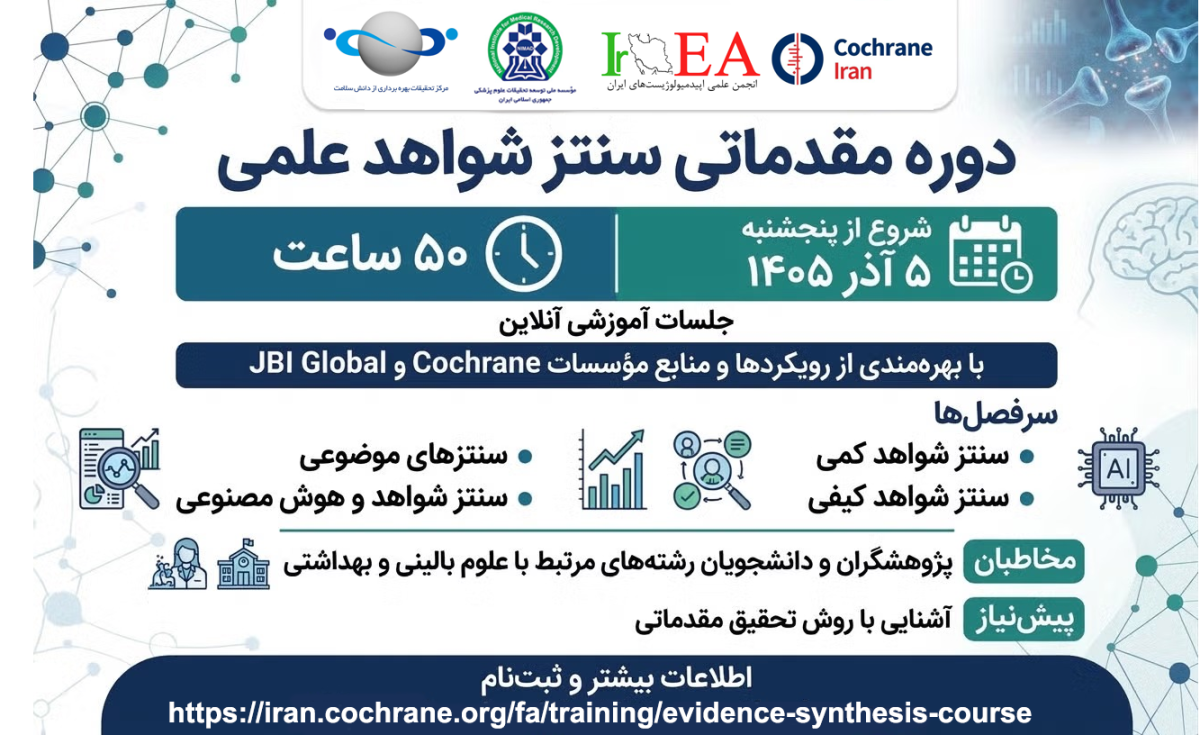
 Course dates: 26 November 2026 to 25 February 2027 (5 Azar to 6 Esfand 1405)
Course duration: 50 hours
Registration deadline: 24 November 2026 (3 Azar 1405)
How to register: https://aveedme.com/a/2090
The session schedule and further details are provided below.
About the Course
The volume of research and scientific evidence across the health sciences is growing rapidly. Every day, researchers publish findings from primary studies that use a wide range of approaches, including basic science research, clinical trials, cohort studies, case-control studies, cross-sectional studies, qualitative research, and economic evaluations.
The findings of individual studies alone, however, are not enough to make effective use of this body of research. To draw on primary research appropriately, the available evidence must be systematically identified, appraised, synthesized, and interpreted through secondary and tertiary research.
**Evidence synthesis** refers to a set of systematic methods for bringing together, appraising, synthesizing, and interpreting findings from primary research. Different types of primary research and different synthesis objectives call for different approaches, each with its own methods and standards.
Evidence synthesis helps clarify what we know about a topic and where further research is needed. It can also reveal inconsistencies across studies and help explain why their findings differ.
Why This Course Matters
Evidence synthesis has received increasing attention in recent years as evidence-based decision-making has become more widespread. When decisions about health, policy, or service delivery rely solely on individual studies, tacit knowledge, personal experience, or unsystematic interpretations of primary research, resources may be wasted and services may prove ineffective or even harmful.
Using evidence appropriately means identifying and appraising relevant studies systematically and transparently. It also means interpreting their findings in light of the quality of the evidence, the risk of bias, differences among studies, and the settings in which they were conducted. Understanding the principles and methods of evidence synthesis and the foundations of evidence-based decision-making is therefore an important skill for researchers and anyone who produces, communicates, evaluates, or applies scientific knowledge.
Conducting a high-quality evidence synthesis requires a range of methodological skills: formulating a research question, designing a search strategy, selecting studies, extracting data, assessing risk of bias, synthesizing findings, assessing the certainty of the evidence, and reporting results according to established standards. Failure to meet those standards at any stage can compromise the validity and usefulness of the findings.
This course provides structured, practical training in the foundations, methods, and applications of evidence synthesis. It aims to improve the quality of evidence synthesis research and strengthen researchers’ ability to produce and use reliable evidence.
Overall Aim
The course aims to help participants develop a coherent understanding of the foundations and applications of evidence synthesis and its role in evidence-based decision-making. It also promotes the use of standard methods and the development of professional skills in the field.
Although artificial intelligence increasingly helps with some tasks in evidence synthesis, specialists must still conduct or supervise study design, oversight of the synthesis process, quality assessment, and interpretation of findings. Given the volume of primary research and the continuing development of synthesis methods, students and researchers working in this field need to keep their knowledge and skills up to date.
Learning Objectives
By the end of the course, participants should be able to:
- Select an appropriate type of review based on the research question and the evidence needed.
- Describe the foundations and methods of the main types of evidence synthesis.
- Explain the key considerations in developing an evidence synthesis proposal and protocol.
- Identify the general principles of systematic searching, study selection, and data extraction.
- Describe methods for assessing risk of bias and the certainty of the evidence.
- Explain the general principles of synthesizing and interpreting study findings.
- Identify the main reporting standards for evidence syntheses.
- Critically appraise evidence synthesis proposals, protocols, and articles.
- Make better-informed use of synthesized evidence in research, education, clinical practice, and health policy.
Who Should Attend
The course is designed for:
- Faculty members at universities of medical sciences and other relevant universities.
- Students in health-related disciplines at all levels of study.
- Researchers and specialists interested in evidence synthesis methods.
- Professionals and others who produce, appraise, communicate, or use scientific evidence within the health system.
Note: The approaches and resources used in this course, particularly those from Cochrane and JBI Global, focus primarily on clinical and health systems research. The course may therefore not cover all the methodological needs of researchers in the basic medical sciences.
Organizers and Collaborators
The course is organized by Iran’s National Institute for Medical Research Development (NIMAD), with support from the Iranian Epidemiological Association and Cochrane Iran, and with the participation of faculty members and specialists in evidence synthesis.
Given the role of evidence synthesis in knowledge translation, the Health Knowledge Utilization Research Center serves as the course organizer and is responsible for operational oversight, coordination among participating institutions, and overall program management.
Course Format and Certificates
- All sessions will be held online.
- Participants have up to 24 hours after each session to take the corresponding offline assessment.
- A separate certificate of participation will be issued for each session to participants who attend the live online class and achieve the minimum passing score on its assessment.
- Participants who attend all sessions of the introductory course and successfully meet its educational requirements will receive a course completion certificate.
Certificate requirement: Both live online attendance and a passing score on the corresponding offline assessment are required.
Registration Fees
- Individual two-hour session | 200,000 tomans |
- Full course — standard rate | 4,000,000 tomans |
- Full course — faculty members | 3,500,000 tomans |
- Full course — students | 2,500,000 tomans |
Instructors
Epidemiology faculty members and Cochrane-approved instructors will teach the sessions according to the schedule below.
Course Schedule
The schedule below presents all 25 online sessions of the 50-hour introductory evidence synthesis course. Dates are retained in the Persian calendar as provided; the schedule begins on Thursday, 26 November 2026, and concludes on Thursday, 25 February 2027.
Module | Topic | Online hours | Date | Time | Instructor |
|---|---|---|---|---|---|
Foundations and Introduction
| The evolution of knowledge production in the health sciences: from primary research to secondary and tertiary research, and living systematic reviews | 2 | Thursday, 25 Nov. | 08:00–10:00 | Bahareh Yazdizadeh |
General principles and introduction to types of review studies | 2 | Thursday, 25 Nov. | 10:00–12:00 | Bita Mesgarpour | |
Searching for evidence | 2 | Saturday, 28 Nov. | 18:00–20:00 | Payam Kabiri | |
Quantitative Evidence Synthesis | Systematic reviews of interventions | 2 | Thursday, 3 Dec. | 09:00–11:00 | Ali Kabir |
Systematic reviews of prevalence and incidence | 2 | Saturday, 5 Dec. | 18:00–20:00 | Mohsen Shati | |
Systematic reviews of measurement properties | 2 | Thursday, 10 Dec. | 09:00–11:00 | Ali Kabir | |
Quantitative Evidence Synthesis | Systematic reviews of diagnostic test accuracy (DTA) | 2 | Saturday, 21 Azar | 18:00–20:00 | Yousef Moradi |
Systematic reviews of etiology and risk | 2 | Thursday, 12 Dec. | 09:00–11:00 | Ayat Ahmadi | |
Dose-response meta-analysis | 2 | Saturday, 19 Dec. | 18:00–20:00 | Ali Kabir | |
Risk-of-bias assessment | 4 | Thursday, 24 Dec. | 08:00–12:00 | Mohsen Shati | |
Meta-analysis of diagnostic test accuracy studies | 2 | Saturday, 26 Dec. | 18:00–20:00 | Yousef Moradi | |
Meta-analysis of clinical trials | 2 | Thursday, 31 Dec. | 09:00–11:00 | Hossein Molavi | |
Network meta-analysis | 2 | Saturday, 2 Jan. | 18:00–20:00 | Amin Doosti Irani | |
Assessing the certainty of evidence from quantitative reviews (GRADE) | 4 | Thursday, 21 Jan. | 08:00–12:00 | Hamidreza Baradaran | |
Special Topics | Patient and public involvement (PPI) in evidence synthesis | 2 | Saturday, 23 Jan. | 18:00–20:00 | Ayat Ahmadi |
Artificial intelligence-assisted knowledge synthesis | 2 | Thursday28 Jan. | 09:00–11:00 | Hossein Molavi | |
Topic-Based Syntheses | Evidence gap mapping | 2 | Saturday, 30 Jan. | 18:00–20:00 | Ayat Ahmadi |
Scoping reviews | 4 | Thursday, 4 Feb. | 08:00–12:00 | Rasoul Masoumi | |
Qualitative Evidence Synthesis | Systematic reviews of qualitative studies: qualitative and textual evidence | 4 | Thursday, 18 Feb. | 08:00–12:00 | Bahareh Yazdizadeh |
Assessing the certainty of evidence from qualitative reviews (CERQual) | 4 | Thursday, 25 Feb. | 08:00–12:00 | Arash Rashidian | |
Total |
| 50 |
|
|
|
Registration
Registration closes on 24 November 2026 (3 Azar 1405).
Register at https://aveedme.com/a/2090.